
PROJECT INFORMATION
Reassessing a proposed AUD $850,000 office fitout to establish a more flexible, evidence led leasing and capital investment strategy.
SIZE
900 m2
A Demand Led Approach to Office Leasing & Investment
LOCATION
SYD CBD
INDUSTRY
Commercial Office
SERVICES
Leasing Readiness & Space Strategy
Asset Strategy & Capital Improvements
Workplace Test Fits & Space Planning
Preliminary Project Feasibility
Capital Expenditure & Procurement Strategy

A Significant Investment. Without a Clear Leasing Strategy.
A commercial property owner approached TOR with a designer prepared proposal for a 900 m² office floor, divided into four separate tenancies.
The proposed fitout had been priced by a contractor at approximately AUD $850,000. While the design provided a complete solution for the floor, the owner remained uncertain whether delivering all four tenancies simultaneously represented the most appropriate investment.
The leasing agent's advice was primarily focused on market presentation and tenant appeal, while the contractor's proposal centred on delivering the complete construction scope.
What remained unresolved was the underlying investment decision: how much capital should the landlord commit before securing evidence of tenant demand?
TOR's role was to provide an independent assessment connecting leasing considerations, spatial planning, technical feasibility and capital allocation.
01 / THE CONTEXT
Challenging the Scope Before Committing the Capital.
Rather than accepting the proposed fitout scope as the starting point, TOR reconsidered the investment strategy from the owner's perspective.
The assessment focused on whether the proposed tenancy configuration reflected occupier demand, how the floor could accommodate different leasing requirements and whether a staged improvement programme could reduce the owner's upfront financial exposure.
Four key considerations informed the review:
02 / THE STRATEGY
Leasing Demand
Assessing the suitability of smaller office tenancies against the target market and available leasing evidence.
Spatial Flexibility
Evaluating alternative subdivisions while preserving the ability to respond to different occupier requirements.
Capital Efficiency
Distinguishing between works necessary to prepare the floor for leasing and those that could be deferred until tenant requirements were established.
Delivery Risk
Considering the implications of subdivision for building services, circulation, compliance, programme and construction costs.

Invest According to Demand. Not Assumptions.
Based on the leasing evidence available for assessment, the recommended direction was to shift investment away from a fully committed four-suite fitout towards a demand-led subdivision and leasing strategy.
The preliminary proposal was to reconfigure the floor into three smaller tenancies, comprising one market-ready speculative suite and two flexible leasing opportunities.
This would allow the landlord to establish a tangible leasing product while retaining flexibility for prospective occupiers and avoiding the immediate capital commitment associated with fitting out all three suites.
Importantly, the proposed strategy was not simply to reduce the construction scope. It was to establish a more deliberate relationship between leasing demand, capital expenditure and investment timing.
03 / THE RECOMMENDATION
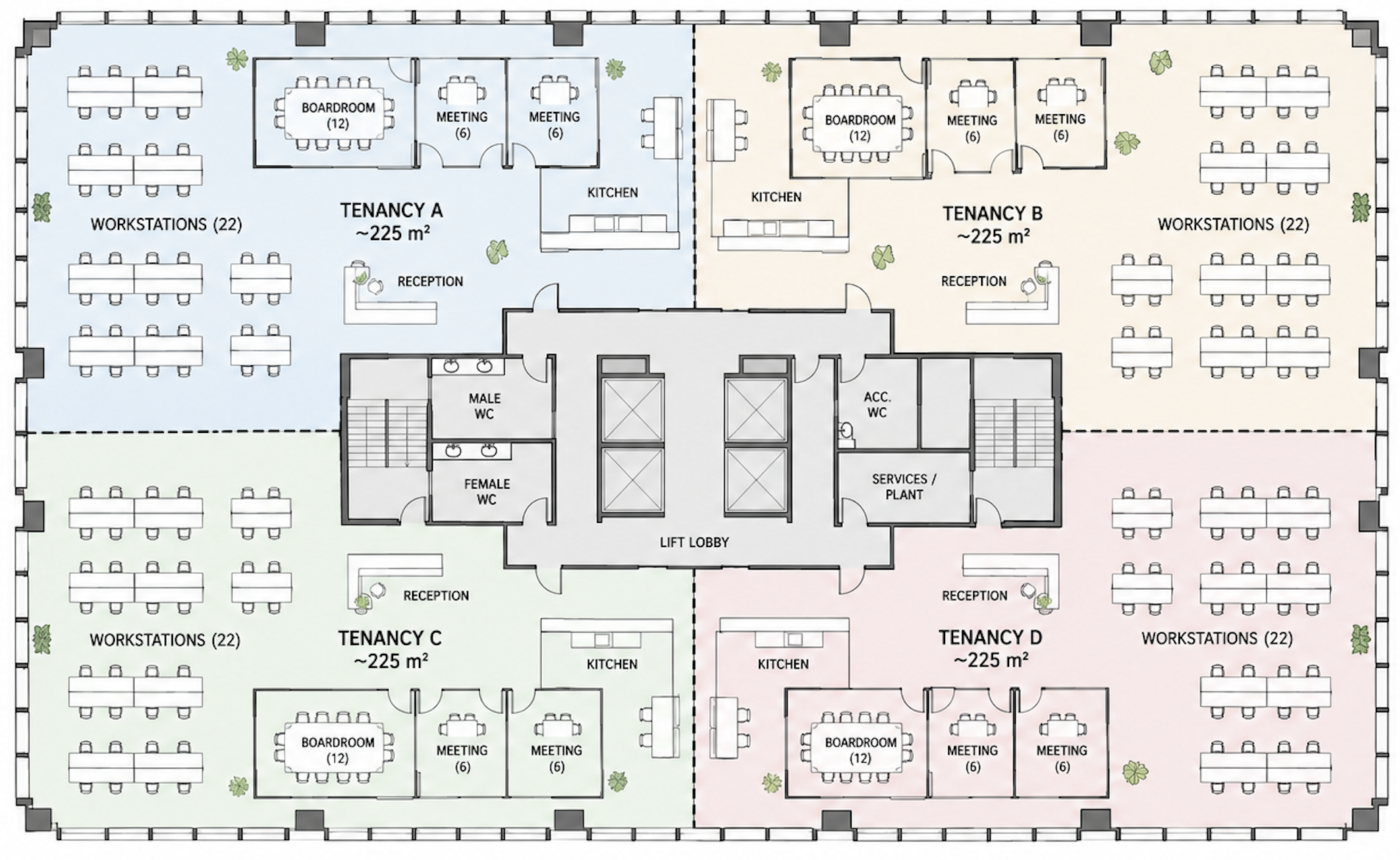
Original Designer’s Plan
Four tenancies with full fitout scope
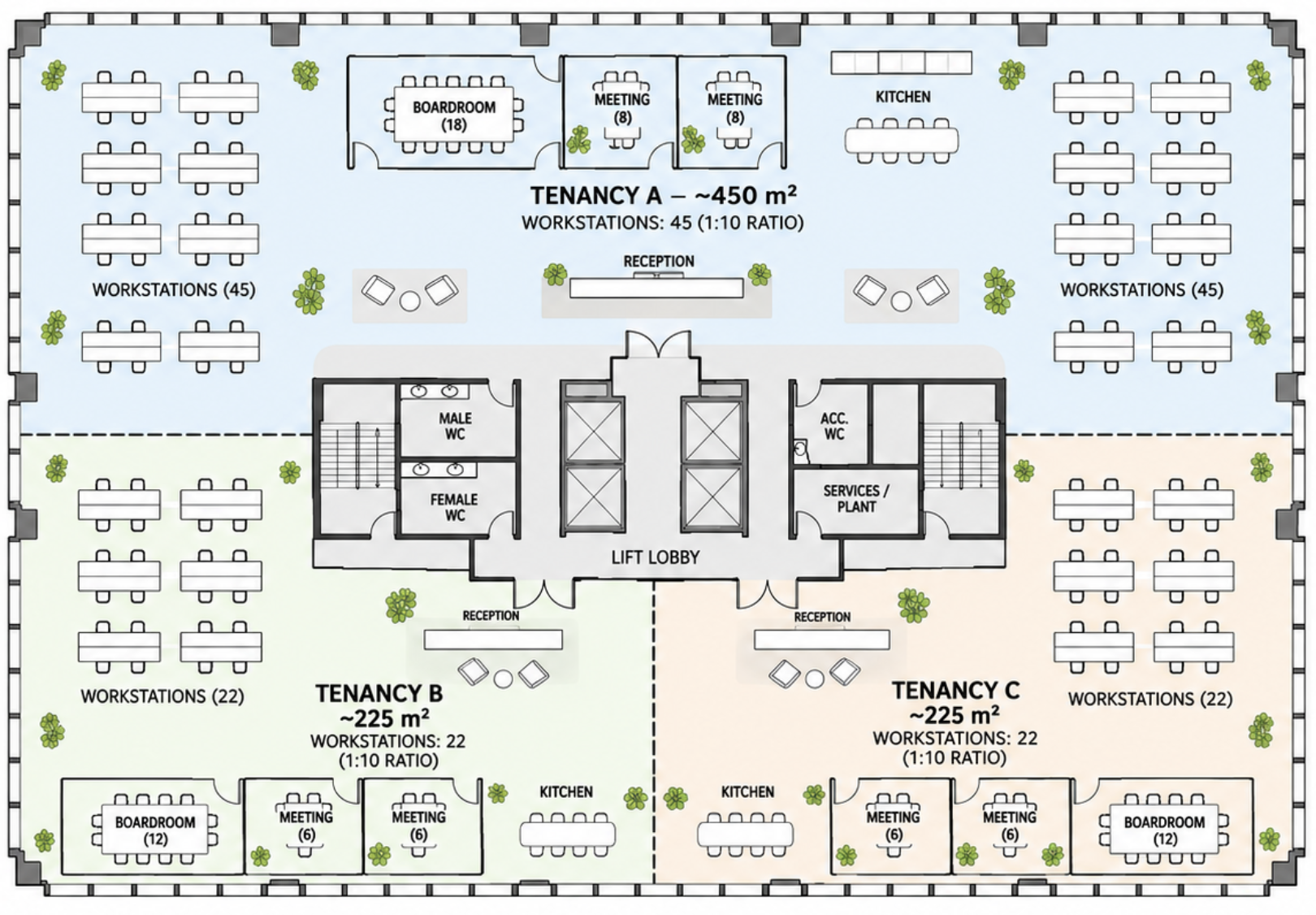
TOR’s Recommendation
* This is a high-level, indicative test fit prepared for illustrative purposes only. The final design and detailed tenancy layouts are confidential and cannot be disclosed.Three tenancies with one market ready spec suites and two flexible leasing opportunities
Before implementation, TOR would undertake further validation of the proposed three-tenancy arrangement.
Testing the proposed subdivision against an updated NLA schedule, including the commercial implications of shared access and any loss of lettable area.
Confirming the capacity and distribution of mechanical, electrical, fire and other building services, together with the requirements associated with the proposed subdivision.
01 /
Building Services Feasibility
02 /
Leasing Market Benchmark
Reviewing comparable leasing transactions, tenancy size preferences, effective rental expectations, incentives and anticipated leasing periods.
03 /
Revised Net Lettable Area
Comparing fitout costs, expected rental income, leasing incentives, potential vacancy exposure and investment returns for each proposed tenancy.
04 /
Suite by Suite Financial Assessment
A Strategy Supported by Evidence.
04 / VALIDATION BEFORE COMMITMENT
Rather than approving the full construction budget upfront, TOR proposed a staged investment framework.
Confirming the capacity and distribution of mechanical, electrical, fire and other building services, together with the requirements associated with the proposed subdivision.
Gate 01 — Feasibility & Investment Approval
Capital Released in Stages. Decisions Made at Defined Gates.
05 / INVESTMENT STRATEGY
Complete the approved subdivision-enabling works and deliver one market ready speculative suite.
Evaluate enquiry levels, tenant requirements, achieved leasing terms and the performance of the initial speculative suite.
This approach maintains the option to invest further without requiring the owner to commit the entire proposed fitout budget at the outset.
Determine whether further fitouts are warranted based on demonstrated market demand and updated financial assessments.
Gate 02 — Initial Leasing Investment
Gate 03 — Market Response
Gate 04 — Subsequent Capital Commitment
The proposed strategy reframed a construction procurement decision as an asset investment decision.
Instead of asking whether the landlord should proceed with an AUD $850,000 fitout, the assessment established a more fundamental question:
What is the minimum appropriate investment required to create competitive leasing opportunities, and when should further capital be committed?
The resulting recommendation provided a framework for more flexible leasing, reduced initial capital exposure and greater alignment between improvement expenditure and market demand.
The financial benefits remain subject to detailed feasibility, market validation and implementation outcomes.
ORIGINAL PROPOSAL
$850K
4 Suites
Four tenancies, complete fitout proposed upfront
06 / THE STRATEGIC OUTCOME
A Lower Risk, Higher Intelligence Leasing Strategy
TOR RECOMMENDATION
$494k
3 Suites
One market-ready suite, two flexible leasing opportunities
The shift is not from four suites to three. It is from speculative capital commitment to evidence led investment.